

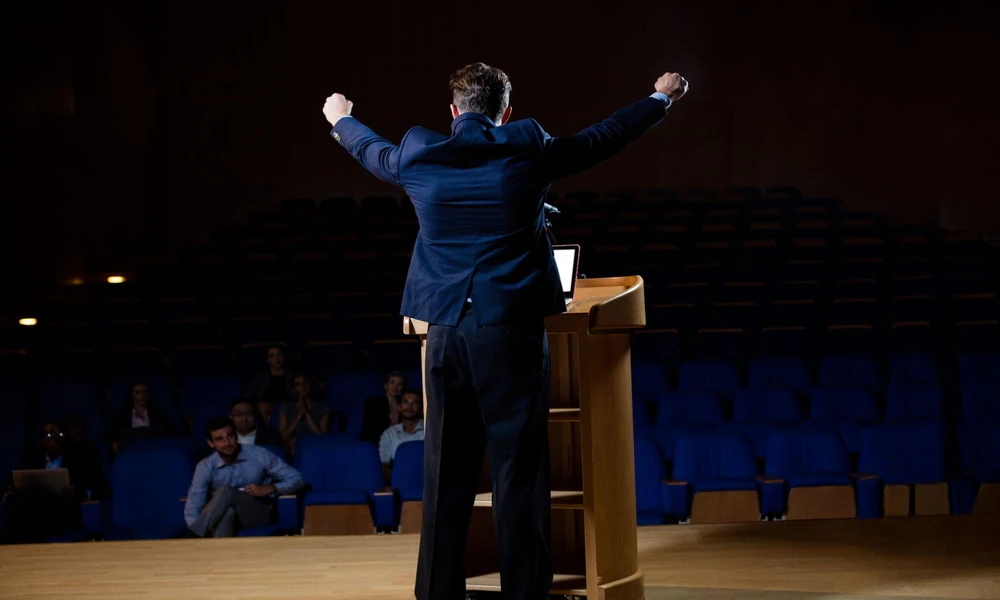
A keynote speaker runs four minutes over. A panel discussion generates more questions than the schedule allows for. A technical glitch eats ninety seconds nobody budgeted. None of this is visible to most of the room, because a good conference emcee has already quietly absorbed the delay somewhere else in the day, without a single audience member ever noticing the schedule wobbled at all.
The audience simply experiences a day that felt well organised. What actually happened behind that impression was a series of small, constant adjustments nobody in the room was ever meant to see.
Why a Conference Runs on a Cascading Schedule, Not a Loose One
A wedding or a product launch can usually absorb a few minutes of drift without much consequence. A conference agenda is a considerably tighter chain, one keynote, several panels, breakout sessions, networking breaks, often stacked back to back across an entire day, sometimes across several rooms running in parallel. A delay in the morning doesn’t stay contained to the morning, it pushes into lunch, which pushes into the afternoon sessions, which pushes into whatever’s scheduled to close the day. Managing that cascade in real time, not just reading from a run sheet, is where a conference emcee’s actual value tends to concentrate.
This is precisely why the format matters so much when choosing who hosts a specific event. What works beautifully for a two-hour dinner doesn’t automatically transfer to an eight-hour programme with a dozen moving parts.
Why This Skill Rarely Gets Named When People Describe a Good Emcee
Most conversations about hiring an emcee focus on stage presence, voice, and energy, the qualities that are immediately obvious watching a highlight reel. The skill that actually determines whether a conference day runs smoothly, reading a room’s timing in real time and adjusting on the fly, rarely shows up in a showreel at all, since by definition it’s invisible when done well. A genuinely experienced conference emcee brings this kind of real-time schedule management as a core skill, not an afterthought layered on top of stage presence.
Why the Best Transitions Are the Ones Nobody Remembers
A transition between speakers that goes well doesn’t register as a moment at all, the previous speaker finishes, a brief, well-placed summary bridges the gap, the next speaker is introduced with exactly the right framing, and the room simply moves forward without any sense of a seam. A transition handled poorly, an awkward pause, a fumbled introduction, an obvious scramble to fill dead air, becomes the moment people actually remember from the day, for entirely the wrong reasons. The gap between these two outcomes is almost entirely about preparation and composure under pressure, not charisma alone.
Why Broadcast Experience Translates Directly Into This Particular Skill
Live broadcast work trains exactly this instinct, reading a run of show in real time, adjusting pacing on the fly, filling unexpected gaps smoothly without ever letting the audience sense anything went off script. An emcee in Singapore with a genuine broadcast background carries this discipline directly into a conference setting, treating a live agenda the same way a news broadcast treats a run sheet, as something to be managed calmly and continuously, not simply followed until something eventually goes wrong.
Why Organisers Rarely Notice This Skill Until It’s Missing
A conference that runs smoothly rarely prompts anyone to comment specifically on the emcee’s timing, it simply feels like a well-organised day. The absence of that skill is what actually gets noticed, a Q&A session cut short without warning, a keynote rushed through its final points, a program that quietly runs forty minutes over by the closing remarks. This asymmetry, invisible when present, glaringly obvious when absent, is exactly why the skill deserves more attention during the hiring conversation than it typically receives.
Asking directly how a prospective emcee handles an unexpected delay tends to reveal far more than asking to see a highlight reel ever could.
Nobody leaves a well-run conference talking about how smoothly the schedule was managed, because they never noticed it happening at all. That’s really the whole point. The emcees worth remembering aren’t necessarily the loudest presence on stage, they’re the ones who made an entire day of moving parts feel effortless, one quiet adjustment at a time.
That’s a considerably harder thing to demonstrate in a showreel than energy or charisma, but it’s usually the difference organisers actually feel once the day is finally over.
Planning a conference and want the schedule genuinely handled? Contact Wayne Chan to discuss what your programme actually needs.